Sustainable Passive Cooling: UK's First Electricity-Free Underground Fridge Unveiled
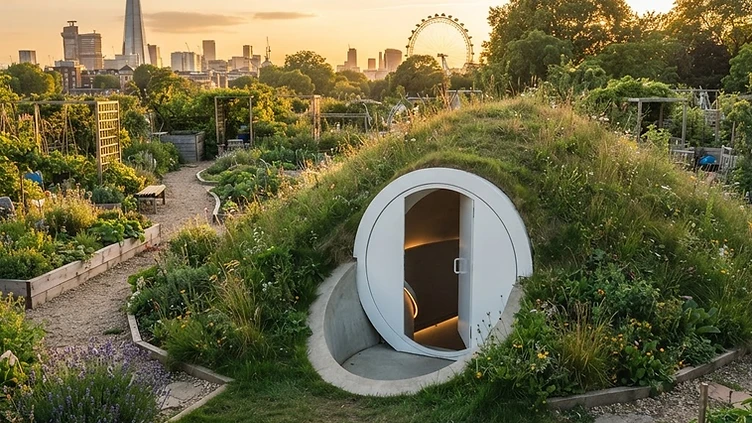
A pioneering 'Groundfridge' that utilizes soil insulation to maintain low temperatures without electricity has been installed at a community garden in north London. This innovative storage solution provides a 3,000-litre capacity for fresh produce, offering a climate-resilient alternative to traditional high-energy refrigeration.
The story in 20 seconds
20The Groundfridge is a pre-fabricated subterranean cellar designed to store food and wine without using any electricity.
Dutch designer Floris Schoonderbeek developed the system as a modern interpretation of traditional root cellars and ice houses.
The inaugural UK installation is located at OmVed Gardens, a two-acre urban green space in Highgate, North London.
A Cool Revolution Beneath the Soil
In the heart of North London, a quiet transformation has taken root within the fertile earth of . As the UK faces increasingly unpredictable summers, a pioneering solution to food storage has emerged on Highgate Hill. This July, the garden unveiled the nation’s first , a subterranean marvel that echoes the wisdom of the past while embracing the sustainability requirements of the future. Developed by Dutch inventor , this innovative system brings the concept of the traditional root cellar into the modern age, offering a brilliant, electricity-free way to keep our produce fresh. By harnessing the natural thermal mass of the earth, provides a high-capacity storage solution that feels less like a gadget and more like a permanent, foundational part of the landscape. Standing as a testament to ingenuity, it represents a shift toward more resilient, self-sufficient living in our urban green spaces.
Returning to Ancient Cooling Roots
The brilliance of the Groundfridge lies in its simplicity. Rather than relying on power-hungry mechanical systems, it uses the natural insulation provided by a one-metre thick layer of soil. Once the spherical, hand-layered polyester unit is buried, it creates a stable, cool environment where temperatures remain consistently between 8°C and 15°C throughout the entire year. Even during the peak of an intense summer heatwave, the of the unit stays remarkably steady, offering a climate-resilient sanctuary for food and wine. Because it lacks the mechanical fans found in traditional kitchen appliances, the Groundfridge also avoids the drying effect that so often compromises the quality of stored fruits and vegetables. It is a modern interpretation of the old-world ice house, perfectly adapted for contemporary needs. With a staggering storage capacity of approximately 3,000 litres, this single buried unit holds the equivalent volume of twelve standard domestic refrigerators. Whether it is shielding the harvest of an urban allotment or keeping garden-grown supplies at the perfect temperature, the Groundfridge proves that we do not always need sophisticated electronics to achieve high-performance results. The construction is as robust as it is clever, with the hand-layered polyester shell providing a durable barrier against moisture, intrusive roots, and common soil-borne pests.
Building a More Sustainable Future
The integration of this technology at OmVed was driven by social entrepreneur , whose work with the garden as a community interest company centers on the vital importance of permaculture and urban agricultural education. By adopting this system, the team has taken a bold step toward true self-sufficiency. In an era where power outages can leave households vulnerable, the Groundfridge stands as a reliable, ever-operational backbone of food security. It is a shining example of how a singular project can serve as a powerful demonstration for the wider UK, highlighting the potential for zero-carbon cooling in our towns and cities. While the initial capital investment for a unit sits at approximately £12,000 plus VAT, the absence of ongoing electricity costs paints an optimistic picture for the long term. For organisations and individuals committed to lowering their carbon footprint, the transition to passive cooling is not just an environmental win; it is a practical, sensible investment in a changing climate. Accessing the store is simple, with an integrated staircase leading to a minimalist entrance hatch that sits discreetly at the top of the grassy mound. It is a design that respects the beauty of the garden while performing a heavy-duty task behind the scenes.
A Legacy of Resilient Storage
As we look ahead, the at Highgate Hill provides a template for others to follow. Whether used by community gardens, small-scale producers, or those dreaming of a more sustainable lifestyle, the Groundfridge highlights that smart design can drastically reduce our reliance on energy-intensive infrastructure. It brings the focus back to the earth beneath our feet, reminding us that nature provides us with the tools we need to thrive if we are willing to listen. The project at OmVed Gardens is more than just a storage unit; it is a signal of progress in the London and South region and beyond. As more people seek out ways to live in harmony with the environment, solutions that remove the need for electricity while providing superior preservation will surely become a staple of modern sustainability. By bridging the gap between historical cooling methods and contemporary engineering, this initiative invites us all to rethink our relationship with the resources we consume. It is a warm, welcome development that shows that the future of cooling might just be found exactly where we started—deep within the cooling, constant comfort of the soil.
Originally reported by
All rights in the original reporting remain with the publishers below.
Originally reported by The underground fridge that keeps food cool – even in a heatwave. Our feature is written independently from verified facts — please support the original reporting:
Read the original storyRelated Wins

 Sport
SportCHESS PRODIGIES BREAK BARRIERS IN NATIONAL LEAGUE DEBUT
The 'She Plays to Win' Lionesses have made history by competing in the top division of the Four Nations Chess League, marking the culmination of three consecutive promotions. Despite facing unique regulatory challenges regarding team composition, the squad continues to demonstrate exceptional skill and camaraderie at the highest level of British chess.
London & South · 5 hours ago

 Science
NEW PATHWAYS TO DIAGNOSIS: CAMBRIDGE STUDY SHEDS LIGHT ON AUTOIMMUNE HEALTH
A landmark study from the University of Cambridge is paving the way for more accurate medical care by highlighting critical gender disparities in the diagnosis of autoimmune conditions. By identifying how and why these misdiagnoses occur, researchers are providing the evidence needed to ensure patients receive faster, more effective support for their physical health.
London & South · 5 hours ago

 Environment
A NATURAL REVIVAL FOR BARNES GREEN
A major river restoration project has successfully transformed the Beverley Brook at Barnes Green into a thriving, natural habitat. This initiative has introduced a meandering river channel and a new island, significantly boosting local flood resilience and biodiversity.
London & South · 11 hours ago
The Sunshine Digest
One bright email each week — verified good news only, unsubscribe in a click.