Breathing in the Deep: The Scottish-Led Discovery of 'Dark Oxygen' Rewriting Earth’s History
A pioneering team from the Scottish Association for Marine Science has discovered that the deep ocean produces oxygen in total darkness via "geo-batteries." This paradigm-shifting find challenges our understanding of the origins of life and underscores the vital importance of protecting the seafloor.
The story in 20 seconds
20Professor Andrew Sweetman led a research team at the Scottish Association for Marine Science in Oban that discovered dark oxygen produced in the deep ocean.
The discovery of oxygen production in the Pacific Ocean was published in the journal Nature Geoscience.
Researchers identified dark oxygen production four kilometers beneath the ocean surface within the Clarion-Clipperton Zone.
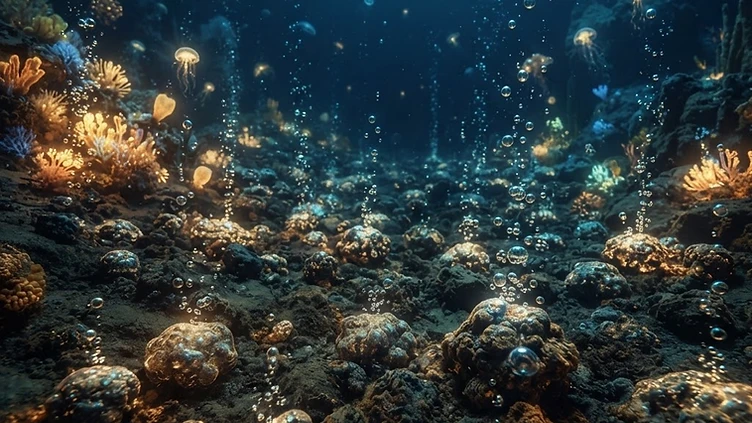
For decades, the fundamental law of biology taught in every classroom has been clear: oxygen is the byproduct of photosynthesis, a process requiring sunlight. Yet, a groundbreaking discovery led by of the Scottish Association for Marine Science (SAMS) in Oban has shattered this scientific dogma. In the pitch-black depths of the Pacific Ocean, four kilometers beneath the surface, researchers have found evidence of "dark oxygen"—O2 being produced not by plants or light, but by the very rocks on the seafloor.
This discovery, published this week in the journal , emerged from expeditions to the (CCZ), a vast abyssal plain between Hawaii and Mexico. The implications are profound, potentially rewriting the history of how life began on Earth and providing a critical new lens through which we must view the health of our oceans. For the team at SAMS, it represents a triumph of British maritime research and a testament to the mysteries that still lie hidden in the deep.
The Mystery of the Abyssal Plains
The journey toward this discovery began nearly a decade ago, but it was only through recent, rigorous testing that the team could confirm their findings. Professor Sweetman and his colleagues were using benthic chambers—sophisticated underwater laboratories—to measure how much oxygen was consumed by organisms on the seafloor. To their astonishment, the sensors repeatedly showed that oxygen levels were not falling as expected; they were rising.
"When we first got this data, I thought the sensors were faulty," Professor Sweetman admitted in a briefing from the SAMS headquarters. "Every study ever done in the deep sea has seen oxygen being consumed, not produced. We spent years double-checking our equipment, recalibrating sensors, and trying every alternative explanation, but the result remained the same. In the absolute darkness of the abyss, something was creating oxygen."
The source turned out to be polymetallic nodules—small, potato-sized rocks rich in minerals like manganese, nickel, and cobalt. These nodules have long been of interest to mining companies for use in green technologies like electric vehicle batteries, but it appears they have been functioning as natural batteries themselves for millions of years.
Nature's Hidden Power: The Geo-Battery Mechanism
The science behind "dark oxygen" is as fascinating as the discovery itself. The research team discovered that these mineral-rich nodules carry a significant electric charge. By placing tiny probes on the surface of the nodules, they measured voltages of up to 0.95 volts. While this may seem small compared to a standard 1.5V AA battery, it is more than enough to trigger a process called seawater electrolysis.
When multiple nodules are clustered together, their combined electrical potential can split seawater (H2O) into hydrogen and oxygen. This "geo-battery" effect means that the deep ocean has its own internal source of aeration, independent of the atmosphere or the sun-drenched surface layers. This mechanism provides a constant, albeit slow, supply of oxygen to one of the most remote and high-pressure environments on the planet.
Dr. , Director of SAMS, hailed the work as one of the most significant findings in ocean science in recent years. "The idea that oxygen can be produced without photosynthesis is a complete paradigm shift," he noted. "It forces us to rethink everything we thought we knew about the distribution of life in the deep ocean and the very chemistry of the sea."
A Crucible for Life and Conservation
The discovery has immediate and urgent implications for environmental policy. The Clarion-Clipperton Zone is currently a focal point for the burgeoning deep-sea mining industry. Companies argue that the minerals found in these nodules are essential for the global transition to renewable energy. However, the SAMS study suggests that removing these nodules could do far more than just disrupt the physical habitat; it could literally suffocate the local ecosystem.
"We now know that these nodules are likely supporting life in ways we never imagined," Sweetman explained. "The deep-sea floor is not just a graveyard of organic matter falling from above; it is a dynamic, oxygen-producing environment. If we remove these 'batteries,' we might be turning off the life-support system for thousands of species that we haven't even discovered yet."
This research provides a powerful scientific foundation for conservationists and policymakers who are calling for a moratorium on deep-sea mining. It highlights the "precautionary principle," suggesting that our understanding of the deep ocean is still in its infancy and that industrial intervention could have irreversible consequences on the planet's biological heritage.
Beyond Earth: The Interstellar Implications
Looking further ahead, the discovery of dark oxygen has ignited excitement within the astrobiology community. If oxygen can be produced on the seafloor through mineral electrolysis, it opens up the possibility that life could exist on icy moons within our solar system, such as Jupiter’s Europa or . These moons are thought to have vast subsurface oceans hidden beneath thick shells of ice, where sunlight cannot penetrate.
Previously, scientists wondered how aerobic life could survive in such environments without photosynthesis. The geo-battery mechanism provides a viable answer. If similar mineral deposits exist on the floors of those alien oceans, they could be pumping out enough oxygen to support complex life forms, independent of a host star’s light.
As the team at the Scottish Association for Marine Science continues to analyze their data, the mood is one of profound optimism. This discovery serves as a reminder that even in an age of satellite mapping and global connectivity, our own planet still holds secrets capable of changing our entire worldview. In the quiet depths of the Pacific, the rocks are breathing, and in doing so, they are telling a story of resilience, hidden power, and the enduring mystery of life.
Professor Sweetman’s work ensures that Scotland remains at the forefront of global marine science, leading the way in protecting and understanding the last great frontier on Earth. The discovery of dark oxygen is not just a scientific milestone; it is a call to wonder, inviting us to look deeper into the blue heart of our world.
Originally reported by
All rights in the original reporting remain with the publishers below.
Originally reported by BBC News: Scientists discover 'dark oxygen' on ocean floor. Our feature is written independently from verified facts — please support the original reporting:
Read the original storyRelated Wins

 Science
NEW PATHWAYS TO DIAGNOSIS: CAMBRIDGE STUDY SHEDS LIGHT ON AUTOIMMUNE HEALTH
A landmark study from the University of Cambridge is paving the way for more accurate medical care by highlighting critical gender disparities in the diagnosis of autoimmune conditions. By identifying how and why these misdiagnoses occur, researchers are providing the evidence needed to ensure patients receive faster, more effective support for their physical health.
London & South · 3 hours ago

 Culture
Edinburgh’s Iconic Film Festival Sets Dates for Historic 80th Anniversary
The Edinburgh International Film Festival has officially announced that its milestone 80th edition will take place from August 12 to August 18, 2027. This upcoming celebration honours eight decades of cinematic excellence, cementing the city's status as a global hub for independent film and artistic innovation.
Scotland · 2 days ago

 Science
A VISIONARY GREENPRINT FOR BIRMINGHAM’S FUTURE
Birmingham residents have shared a series of inspiring and ambitious ideas for the city’s evolution by the year 2050. This collective vision highlights a strong community desire to transform the urban landscape into a more sustainable, connected, and vibrant place to live.
Midlands · 2 days ago
The Sunshine Digest
One bright email each week — verified good news only, unsubscribe in a click.